The saint
King Stephen's hand
Who King Stephen was, why the basilica carries his name, and what the Holy Right is: the mummified hand kept in the church, as the basilica tells it.
Reserve a seat in the basilica ↗Quick answer
St Stephen's Basilica is named for Stephen I, the first King of Hungary, who died on 15 August 1038 and was canonised in 1083. The basilica keeps the Holy Right, a relic of his right hand, and holds a procession with it every 20 August. Its own account presents the relic as an object of belief, not as a verified fact.
Why the church is named for him
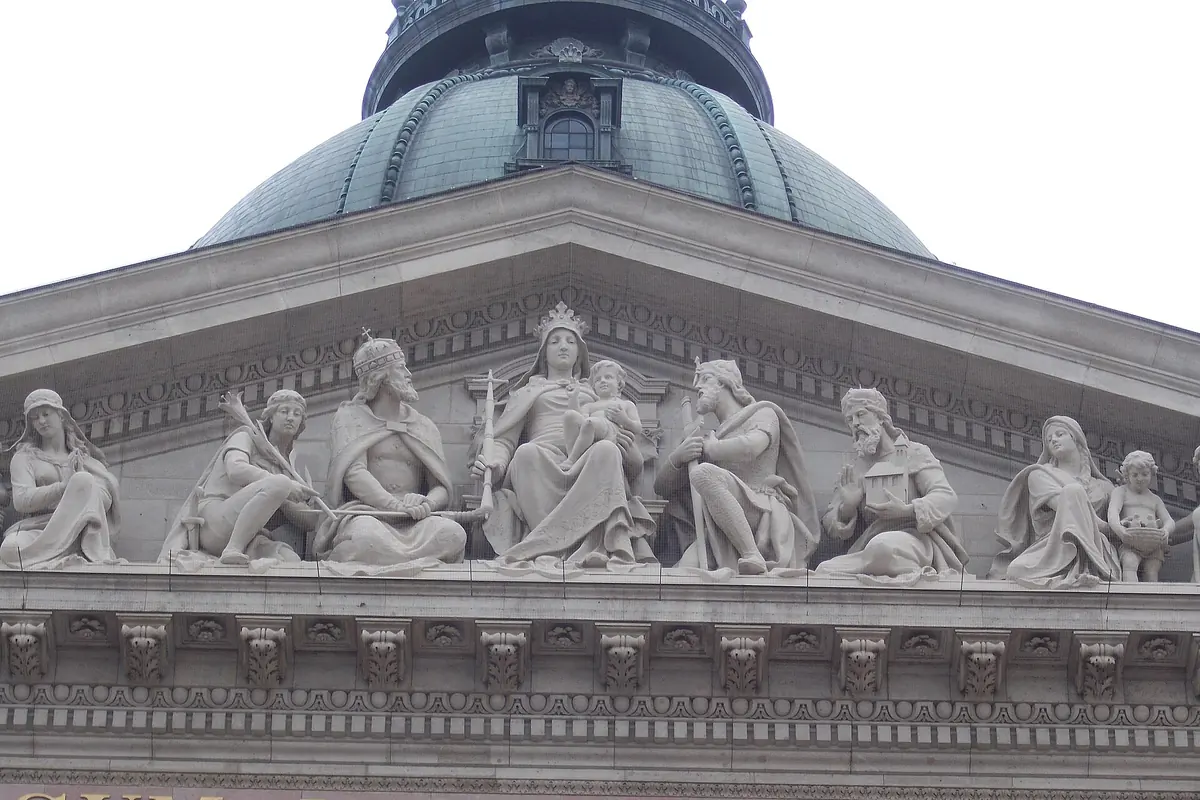
The basilica's history says the church was named after St Stephen, the first king of Hungary, in 1897, years before its consecration in 1905. Wikipedia gives his Hungarian name as István, which is why the square in front of the church is Szent István tér. It adds that he was born Vajk, probably around 975, and ruled as Grand Prince from 997 and as the first King of Hungary until his death. A statue of the king in Carrara marble stands under the canopy of the main altar.
The king and his coronation
Wikipedia says Stephen was crowned on 25 December 1000 or 1 January 1001, and that the crown came from Pope Sylvester II, although historians debate the circumstances. A contemporary chronicler, Thietmar of Merseburg, says he was crowned with the favour and urging of Emperor Otto III. Stephen died on 15 August 1038 and was buried in the basilica he built at Székesfehérvár. Pope Gregory VII canonised him on 20 August 1083, together with his son Emeric and Bishop Gerard of Csanád, and 20 August is his feast day and a public holiday in Hungary.
What the Holy Right is
The Holy Right, or Szent Jobb, is the right hand of King Stephen, preserved as a relic. In the basilica's account, the chapter of Fehérvár moved the king's embalmed body after his death on 15 August 1038 and the right hand was severed; because it remained intact it was believed to have miraculous powers and was taken to the treasury. The basilica reports no scientific authentication. It describes the hand as the relic of the founder of the Hungarian state, and it presents the miracle as a belief.
How the relic came here
The basilica's page follows the relic through the centuries. After the order that guarded it was dissolved in 1865, the Archdiocese of Esztergom became responsible for it, and in the early 1900s it moved to the Sigismund Chapel in the Buda Castle Palace. In 1944 it was smuggled to the West to protect it from the war, and it returned to Hungary on 19 August 1945. In 1950 it was entrusted to the parish of St Stephen's Basilica. Not every date in the page is consistent, so treat the sequence as the basilica's own telling.
The statue and the crown
The basilica says the statue of St Stephen on the main altar is carved in Carrara marble and shows him holding the double cross and the orb, symbols of apostolic and royal power. It stands beneath a canopy surrounded by a colonnade, and at the top is a statue of the Archangel Gabriel holding the Holy Crown, which the basilica says Pope Sylvester II sent to King Stephen at the turn of the first millennium. Bronze reliefs on the back wall show four scenes from his life. Wikipedia names Alajos Stróbl as the sculptor of the statue of St Stephen.
How it is kept and shown
The basilica says the relic is protected by a double reliquary. The outer shrine is chapel-shaped and neo-Gothic, designed by József Lippert and built in Vienna in 1862, and an inner glass cylinder encloses the relic. It stands at the Altar of Our Lady of Hungary in the basilica. Every year on 20 August, Hungarians celebrate the founding king with a procession of the Holy Right. If you visit the church by day, you can look for it there, but note that it is a place of worship and visitors are asked to be respectful.
Read next: Building the basilica
Who this isn't for
The church and the relic are separate visits that a concert ticket does not include. If you want a scientific account of the relic, the basilica's page does not give one. If you are visiting on 20 August, expect crowds and changed opening times, since the feast and procession take priority. If you want only the music, this saint's story is background rather than part of the evening. And if you want the history of the church building rather than of its patron, the guide to the building covers it.
Frequently asked questions
Who was King Stephen?
Stephen I, or István, was the first King of Hungary. He was crowned around the year 1000 and died on 15 August 1038. He was canonised in 1083.
What is the Holy Right?
The Holy Right is the right hand of King Stephen, kept as a relic. The basilica presents it as an object of belief.
When is the procession?
Every year on 20 August, the feast of the king, Hungarians celebrate with a procession of the Holy Right.
Is the relic part of the concert?
No. A concert ticket covers the concert only. The church hall is a separate visit with its own ticket.
Sources